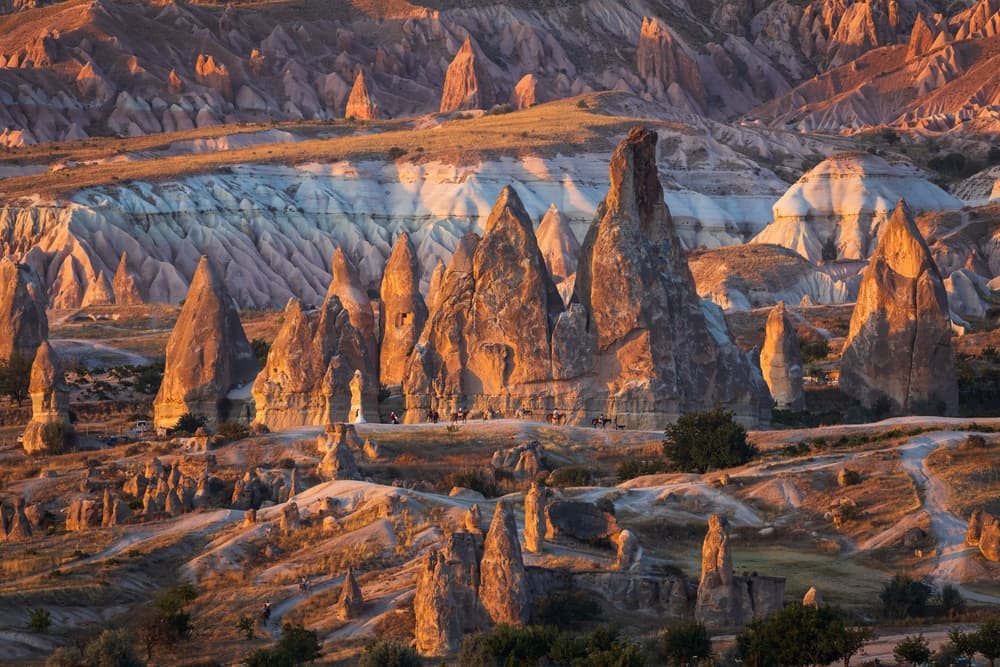
 PAŞABAĞ · 38.67°N 34.85°E · 15 MIN FROM GÖREMEFog on the valley floor below the chimneys, first light in October.
Fairy chimneys: how they formed and where to see them
The fairy chimneys are rock cones with hard caps, formed by volcanic ash and erosion. The best ones stand within 15 minutes of Göreme, and this page tells you which to visit and when.
This page contains figures still being verified with our operations team.
Fairy chimneys are cones of soft volcanic tuff protected by a cap of harder rock, and Cappadocia has thousands of them. The best groups are at Paşabağ, Devrent and Zelve, all within 15 minutes' drive north-east of Göreme, with Çavuşin village on the same road.
Seeing all four takes one half-day. The desk schedules it for late afternoon, when the light turns the cones gold and the coaches have left.
How the fairy chimneys formed
Three volcanoes ring Cappadocia: Erciyes near Kayseri, Hasan near Aksaray and Göllüdağ between them. Millions of years ago their eruptions buried the plateau under ash, which compacted into tuff, a rock soft enough to cut with a knife. Later lava flows laid a thin layer of harder basalt on top.
Rain and wind then went to work. Where the basalt cap stayed, the tuff beneath it was protected, and a column formed as the ground around it washed away. Where the cap cracked and fell, the column wore down quickly. The result is a cone with a hat, sometimes 40 m tall, and the hat is what keeps it standing.
The same softness that built the chimneys let people hollow them out. Hermits, farmers and whole villages cut rooms, chapels and dovecotes into the cones, and the cave hotels you sleep in are the same idea with plumbing.
Why is Cappadocia called the city of jinn?
Arabic-speaking visitors often know the region as madinat al-jinn, the city of jinn, and the name is worth explaining because it is not a marketing invention. The Turkish name for the cones is peri bacaları, fairy chimneys. Villagers saw smoke rising from cave homes inside the rock and explained the columns as chimneys built by fairies, or in other tellings by jinn. No human, they reasoned, could have made such shapes.
The eerie look at dusk, when the cones stand in rows like figures, kept the story alive, and Arabic travel writers carried it over as the city of jinn. There is nothing supernatural at the sites; the nickname is folklore, and the geology above is the real answer. It does make a good story to tell children at Devrent.
Paşabağ, the Monks' Valley
Paşabağ has the chimneys most people picture: thick columns with two or three mushroom caps each, standing in a vineyard. Byzantine hermits lived in them, and one chimney holds a chapel dedicated to St Simeon cut on three levels, which you can climb into by a short ladder.
The site is flat, with a paved path from the car park through the main group and a gravel loop beyond. Allow 45 to 60 minutes. Benches sit in the shade of the chimneys themselves in the afternoon, which is why this is the best of the four sites for grandparents. There is a ticket booth, and the ticket is a joint one with Zelve. It costs [to verify: joint Paşabağ and Zelve ticket, AED per person] per person, indicative as of 23 September 2026, with the live price on the booking page.
Devrent, the Imagination Valley
Devrent is five minutes further along the road towards Ürgüp, and it is free to walk. Nobody lived here; there are no churches or caves. The reason to come is the shapes: a camel, a seal, a hand, a kissing pair, whatever your children decide they see. A guide will point out a dozen; the children will find twenty.
It takes 20 to 30 minutes, the paths are flat and short, and a pram manages the main track. In July the pink rock throws heat back at you after 11:00, so do it first thing or last thing.
Zelve Open-Air Museum
Zelve is a whole village cut into three valleys, inhabited until 1952, when rockfalls made it unsafe and the state moved the families to a new village nearby. Houses, a mosque, churches and a mill are all still there, joined by tunnels and steps.
It takes 60 to 90 minutes and it is the most physical of the four sites. Some rooms are reached by steep steps and one by a ladder tunnel. Teenagers love it. For children under eight and anyone unsteady, Paşabağ and Devrent are enough. Opening hours are seasonal, roughly [to verify: current summer and winter hours for Paşabağ and Zelve], and Zelve's last entry is an hour before closing.
Çavuşin
Çavuşin is the village on the road between Göreme and Paşabağ. Its old quarter is a cliff face of abandoned cave houses below the Church of St John the Baptist, one of the oldest in the region. Ten minutes on the way past is enough for the view; 30 minutes if you climb to the church.
The village is also where the Rose Valley walk begins, so a guided day can join the chimneys with a sunset on the ridge.
When to go and how to combine it
Late afternoon, in every season. The cones face west enough that the last two hours of light colour them, and the coach tours have finished by 16:00. In winter, when snow sits on the caps, the same slot gives the best photograph of the trip.
The natural pairing is the chimneys after lunch and the underground cities in the cooler morning, or the reverse in summer, when the underground city is the midday refuge. Either way it is one day with a driver, priced per vehicle in dirhams, and the guide buys the joint ticket for Paşabağ and Zelve so you queue once.
Is Cappadocia in Istanbul?
No, and the question comes up every week at the desk. Cappadocia is in central Türkiye, about 730 km south-east of Istanbul. The flight from Istanbul to Kayseri or Nevşehir takes about an hour and a quarter; the drive is about nine hours. Most Gulf travellers connect through Istanbul, and Istanbul to Cappadocia explains how.
Questions
- Why is Cappadocia called the city of jinn?
- The Arabic nickname madinat al-jinn comes from the Turkish folk name for the rock cones, peri bacaları, meaning fairy chimneys. Villagers explained the eerie shapes and the smoke from cave homes as the work of unseen beings. Geology explains them today: volcanic ash capped with harder rock, carved by wind and water.
- Is Cappadocia in Istanbul?
- No. Cappadocia is in central Türkiye, about 730 km south-east of Istanbul. You fly from Istanbul to Kayseri or Nevşehir in about an hour and a quarter, or drive about nine hours.
- How were the fairy chimneys formed?
- Eruptions from Erciyes, Hasan and Göllüdağ covered the plateau in ash that became soft tuff, topped by harder basalt. Rain and wind wore the tuff away faster than the cap, leaving cones with hats. Where the cap falls, the cone erodes quickly.
- Which fairy chimneys are best to visit?
- Paşabağ for the mushroom-capped chimneys and the hermit cells, Devrent for the animal shapes children enjoy, Zelve for a whole abandoned cave village, and Çavuşin for the church and the view. Paşabağ and Devrent together take about 90 minutes.
- Are the fairy chimneys suitable for children and older relatives?
- Yes. Paşabağ and Devrent are flat with short paths and benches, and both work with a pram on the main track. Zelve has steep steps and ladders and is better for teenagers and adults.
- UNESCO, Göreme National Park and the Rock Sites of Cappadocia · 2026-09-23
- Turkish Ministry of Culture and Tourism, museums · 2026-09-23
- Go Türkiye, Cappadocia · 2026-09-23
Last checked 23 September 2026